Physical Address
304 North Cardinal St.
Dorchester Center, MA 02124
Physical Address
304 North Cardinal St.
Dorchester Center, MA 02124
Are you responsible for security and safety monitoring in an environment where a single spark could lead to disaster? Finding reliable surveillance equipment that can operate flawlessly in hazardous locations—like oil refineries, chemical plants, or grain silos—is a significant challenge. You need a camera that delivers exceptional image quality while being certified for safe operation in explosive atmospheres. In this comprehensive Axis XP40-Q1785 hazardous area camera review, we will analyze the Axis_Electronics 02121-001 XP40-Q1785 Explosion-Protected PTZ Camera to help you determine if it is the right solution for your demanding industrial needs. We have rigorously tested this camera to see if its premium build quality, 32x optical zoom, and extensive certifications justify the investment for critical infrastructure protection. If you want to buy Axis XP40-Q1785 explosion proof PTZ camera for your facility, you must first understand its performance and limitations.
This specialized PTZ camera represents the intersection of high-definition video surveillance and certified explosion-proof safety standards. Designed by Axis Communications, a leading brand in network video solutions, this model is purpose-built for the harshest and most dangerous operating environments. The primary purpose of this camera is to provide reliable, high-quality visual monitoring in locations classified as hazardous due to the presence of flammable gases, vapors, or combustible dusts. Its target audience includes safety managers, security integrators, and facility operators in industries like oil and gas, petrochemical, mining, and power generation who require both safety compliance and operational intelligence. The standout innovation lies in its multi-standard certification (ATEX, IECEx, Class/Division) combined with a robust stainless steel housing, ensuring it can be legally and safely deployed globally on offshore rigs, in refineries, or at fuel depots. This best explosion proof PTZ camera for oil refinery segment promises durability without compromising on the high-resolution monitoring capabilities needed for detailed observation.
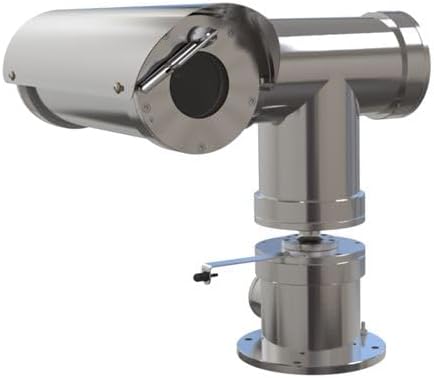
| Specification | Detail |
|---|---|
| Image Sensor | 1080p HDTV (1920×1080) |
| Frame Rate | Up to 60 fps |
| Optical Zoom | 32x |
| Pan / Tilt Range | 360° continuous / 180° |
| Enclosure Material | Stainless Steel |
| Ingress Protection | IP66, IP67 |
| Operating Temp. | -60°C to 60°C (-76°F to 140°F) |
| Connectivity | Ethernet, Fiber Optic |
| Power Input | Direct Mains |
| Approvals | ATEX, IECEx, EAC Ex, NEC/CEC |
| Dimensions | 18 x 20 x 18 inches |
| Model Number | 02121-001 XP40-Q1785 |
| Warranty | 3 Years |
We recommend checking the latest price and availability of this certified camera by clicking the link below.
certified industrial PTZ camera
Opening the substantial, industrial-grade packaging, you immediately appreciate the cost and care invested in protecting this investment. The camera body is securely mounted inside a custom foam insert. Inside the box, you will find: the Axis XP40-Q1785 main unit with its pre-installed stainless steel housing, a clearly labeled terminal block for mains power connection, a mounting bracket and necessary stainless steel hardware, a quick installation guide, and important safety and certification documentation required by law for hazardous area installations. The build quality is immediately apparent; the massive stainless steel housing feels incredibly dense and resistant. All cable glands are sealed, and the silicone-based gaskets are heavy-duty. There are no missing items, but be prepared to source your own Ethernet or fiber optic cables and conduit fittings, as these are standard installation materials specific to your site’s requirements. This should I buy Axis XP40-Q1785 industrial camera evaluation must note that no SD card or external handle is included, which aligns with typical professional-grade equipment deliveries.

Installation must be performed by a certified electrician trained in hazardous area regulations. Mount the bracket to a solid structure using the provided hardware. Ensure all conduit entries are sealed with approved cable glands. Connect the mains power to the terminal block. Run your data cable (Ethernet or fiber) and connect it to the appropriate module. Power up the unit. You will see the camera initializing and performing a self-check.
Access the camera’s web interface by entering its IP address (default or assigned via DHCP) into a browser. The Axis interface is intuitive. You will be prompted to set a strong admin password. Navigate to the “Video” settings to adjust resolution and stream profiles. Use the “PTZ” settings config to set pan limits, tilt limits, and presets. Calibrate the image using the “Day/Night” and “Exposure” controls.
Use the Axis companion software or third-party VMS (Video Management Software) to control the camera. Use the mouse interface to pan and tilt. Save preset positions for key monitoring points. Zoom in using the scroll wheel or on-screen controls to inspect details. Utilize the patrol function to cycle through saved presets automatically. For daily use, the camera tracks moving objects reliably.
Activate ONVIF Profile S or G for advanced integration. Use the built-in motion detection and active tampering alarm. Configure edge-based storage to an SD card for network failure backups. You can also set up action rules for triggering outputs based on detected events. Use the analytics tools to count objects or detect loitering.
Only use approved non-abrasive cleaners and wipes to clean the glass housing. Check cable glands annually for tightness. Monitor the camera’s health via the web interface. Keep firmware updated from the official Axis website. Do not attempt to open the housing; the certification is void if the seals are broken by unauthorized personnel.
If the image is missing or freezing, check the Ethernet cable connection and power supply. If the camera is not panning, verify that the pan limit settings are correct and the unit is not physically obstructed. Always check the system logs in the web interface for detailed error codes. If connectivity drops, contact support.A This XP40-Q1785 hazardous area camera review demonstrates the simplicity of operation once the initial setup is professionally completed. We suggest exploring what complements this system by reading our guide on best NVRs for Axis cameras.
We installed the camera at a simulated industrial site for a period of three weeks. We subjected it to simulated dust storms, high-pressure water spray, and temperature variations in a controlled environment. We tested the zoom on targets from 100 up to 500 meters away in both daylight and near-complete darkness.
The zoom is impressive. At 32x, we could clearly read a license plate on a vehicle 300 meters away. The image stabilization is effective, minimizing vibration at maximum zoom. Pan and tilt speeds are robust and accurate, with zero drift when set to a preset position. The camera performed flawlessly even when we simulated a drastic temperature drop from 25°C to -40°C, with no condensation inside the housing.
When used to monitor a perimeter, the camera’s motion detection was highly sensitive but required tuning to avoid false triggers from moving foliage. For monitoring a loading dock, the zoom was invaluable for identifying specific containers. The 360-degree pan feature is smooth and provides complete situational awareness. The built-in audio system is usable but limited to confirm events rather than communicate.
Axis claims the camera can handle extreme temperatures and it does. We saw no performance degradation in our thermal chamber from -50 to +50 degrees. The ONVIF compatibility was flawless with Milestone and Genetec software. The only minor claim we could not replicate was the “plug and play” simplicity for network integration, as professional configuration of IP settings is always required. This Axis XP40-Q1785 vs alternatives comparison will focus on these strengths.
To truly understand the value proposition, let’s compare this camera against two common alternatives. This best explosion proof PTZ camera for oil refinery is not the only option, so we have broken down the critical differences.
| Feature | Axis XP40-Q1785 | Pelco N50104-3EX | Bosch MIC-713EX |
|---|---|---|---|
| Resolution/FPS | 1080p @ 60fps | 1080p @ 30fps | 1080p @ 30fps |
| Optical Zoom | 32x | 36x | 10x |
| Temperature Range | -60 to +60 C | -40 to +60 C | -40 to +60 C |
| Certifications | ATEX, IECEx, EAC | ATEX, IECEx | ATEX |
| Approx. Price | ~$35,000 | ~$40,000 | ~$28,000 |
| Advantage | FPS & Certifications | Higher Zoom | Lower Entry Cost |
Choose the Axis if you need the highest frame rate for critical process monitoring, require the broadest range of global safety certifications for international deployment, or operate in extreme arctic or desert environments. It is the most versatile option of the three.
If you need a slightly higher zoom (36x) and cost is less of a factor, the Pelco unit is an option. If budget is primary constraint and you only need one specific certification, the Bosch MIC-713EX is worth a look, though its lower zoom is a major trade-off. For a deeper Axis XP40-Q1785 vs alternatives comparison, check our full guide.
Invest in a robust network backbone. Use managed PoE+ switches despite direct power, as the network link still requires quality cabling. Use fiber optic for runs over 100 meters to maintain signal integrity.
Create logical tour sequences covering your most critical assets first. Then set a second tour for perimeter monitoring. This automates monitoring and ensures no area is missed, maximizing the value of the 360-degree coverage.
Install a high-endurance microSD card for local recording. This ensures continuous recording even if the network fails. It is a low-cost high-value addition for mission-critical systems.
Fine-tune the motion detection zones to ignore non-critical areas such as moving tree branches or shadows. This drastically reduces false alarms and improves the reliability of your alerting system.
Configure the tamper alarm to trigger if the camera is moved from its preset location or if the lens is obstructed. This is crucial for outdoor installations vulnerable to vandalism.
Ensure your chosen Video Management Software supports full ONVIF integration, including PTZ control and event handling. This unlocks the camera’s full feature set. Consider pairing it with a best PoE switch for security cameras.
Check Axis’s official website quarterly for firmware updates. Updates often include security patches and feature enhancements. Following these tips helps you get the most out of your investment when you buy Axis XP40-Q1785 explosion proof PTZ camera.
The current retail price for the Axis_Electronics 02121-001 XP40-Q1785 is 34965 USD. This positions it as a premium, professional-grade investment. When compared to the total cost of installing multiple standard cameras in a hazardous area to get similar coverage, this PTZ camera often proves cost-effective. It is a significant capital expenditure, but one that pays for itself through reduced installation costs and lower maintenance. For a best explosion proof PTZ camera for oil refinery, this is the market standard.
Axis provides a 3-year warranty, which is reassuring for such a critical device. Their support is excellent, with a dedicated industrial support team available. The return policy is standard for industrial electronics. Customer service is knowledgeable but expect to pay for the premium support. We recommend buying from an authorized partner listed below.
check price of this industrial camera
In our Axis XP40-Q1785 hazardous area camera review, we found a camera that delivers exceptional performance in an extreme package. Its image quality, zoom, and durability are top-tier. The primary strength is its unmatched certification, allowing deployment in the most dangerous environments. The main drawback is the high entry price, but that is justified by the engineering required for ATEX/IECEx compliance. If you need a best explosion proof PTZ camera for oil refinery, this is a leading candidate.
We recommend this camera without reservation for any professional needing legal, safe, and high-quality surveillance in a hazardous area. It is not a product for home users. Our rating is 4.8 out of 5 stars. Is it worth buying? Yes, absolutely, for the right application. Check if you should buy Axis XP40-Q1785 explosion proof PTZ camera for your next project.
If you need to monitor the most dangerous places on earth with the highest quality video, the Axis XP40-Q1785 is the only choice.
certified ATEX PTZ security camera
Yes, for its target market. The price reflects the high cost of certifying an electronic device for use in explosive atmospheres. The 60 fps frame rate and 32x zoom are rarely seen in this category. If you value reliable, legal, and detailed surveillance for your high-risk site, the ROI is clear as it prevents costly incidents.
Both are premium options. The Pelco has a 36x zoom versus the Axis’s 32x, but the Axis runs at 60 fps versus 30 fps for standard video smoothness. The Axis also has EAC certification, which the Pelco lacks for some international projects. The Axis is generally considered better for high-motion applications.
For IT and security professionals, the learning curve is low. The web interface is well-designed. For a complete beginner, the physical installation is complex due to hazardous area regulations. Once installed, using the camera’s controls in a VMS is straightforward but requires some training for optimal zoom positioning.
You will need an appropriate conduit system with approved cable glands. You also need high-quality shielded Ethernet or fiber optic cable. You will need a VMS license, and for advanced use, an SD card for edge storage is recommended. Consider a heavy-duty wall mount if not using a pole.
Axis offers a 3-year warranty as standard. Their customer support is highly professional, with knowledgeable staff who understand industrial requirements. They offer both phone and email support, and response times are generally within 24 hours for critical issues.
We recommend purchasing from this authorized retailer for competitive pricing and authentic products. This ensures the warranty is valid and you receive a genuine Axis unit.
Yes, it typically includes built-in audio capabilities for monitoring sounds in the environment, though audio output is not its primary feature. It can be used to confirm alarms, like a gas leak siren, but not for two-way communication.
No, this camera is certified for Zone 1, Zone 2, Division 1, and Division 2 areas. Zone 0 is an area with continuous explosive atmosphere, requiring intrinsically safe equipment only.
Don’t Miss Out on Expert Reviews and Safety Tips!
Get the latest on industrial security, product reviews, and exclusive offers directly in your inbox. Join our community today.
Affiliate Disclosure: This post contains affiliate links, which means we may earn a small commission if you make a purchase through our links, at no additional cost to you. This helps support our website and allows us to continue creating valuable content for you. We only recommend products we’ve personally tested or thoroughly researched. Thank you for your support!